

-

 Butchers Twine & String for Hanging MeatButchers Twine & String for Hanging Meat
- Regular price
-
€17,95 EUR - Regular price
-
- Sale price
-
€17,95 EUR
Quick view
-

 Protective Fly Net for Drying Meat & GameProtective Fly Net for Drying Meat & Game
- Regular price
-
€32,95 EUR - Regular price
-
- Sale price
-
€32,95 EUR
Quick view
-

 Accessory Meat Hanging HookAccessory Meat Hanging Hook
- Regular price
-
€22,95 EUR - Regular price
-
- Sale price
-
€22,95 EUR
Quick view
-

 Meatdryer Artisan KitMeatdryer Artisan Kit
- Regular price
-
€190,00 EUR - Regular price
-
- Sale price
-
€190,00 EUR
Quick view
-

 Artisan-Style Tool Roll for Hooks & AccessoriesArtisan-Style Tool Roll for Hooks & Accessories
- Regular price
-
€33,95 EUR - Regular price
-
- Sale price
-
€33,95 EUR
Quick view


Without the guesswork
The hook is what makes this straightforward at home. It takes the guesswork out — and there is more of it than people expect.
Finding the right salt level is an art, and it is hard to get right without guidance. Too little and the meat won't keep. Too much and you've made something nobody wants to eat. It depends on the cut, the method and what you're making, and it is the first place people go wrong.
Then there's knowing when to take it down. Meat doesn't dry at a steady rate — it loses weight quickly at the start and slowly at the end, and how fast depends on the air around it. Too dry, and the outside hardens into a shell before the middle has lost anything, so the moisture is trapped and the piece never finishes. Too humid, and it doesn't dry at all — mould takes the surface instead.
And ready isn't one number. A pancetta you're going to fry is done while it still holds most of its weight. A biltong you'll eat as it is has to go a great deal further. Every recipe carries its own target, and the only way to know you've reached it is to weigh.
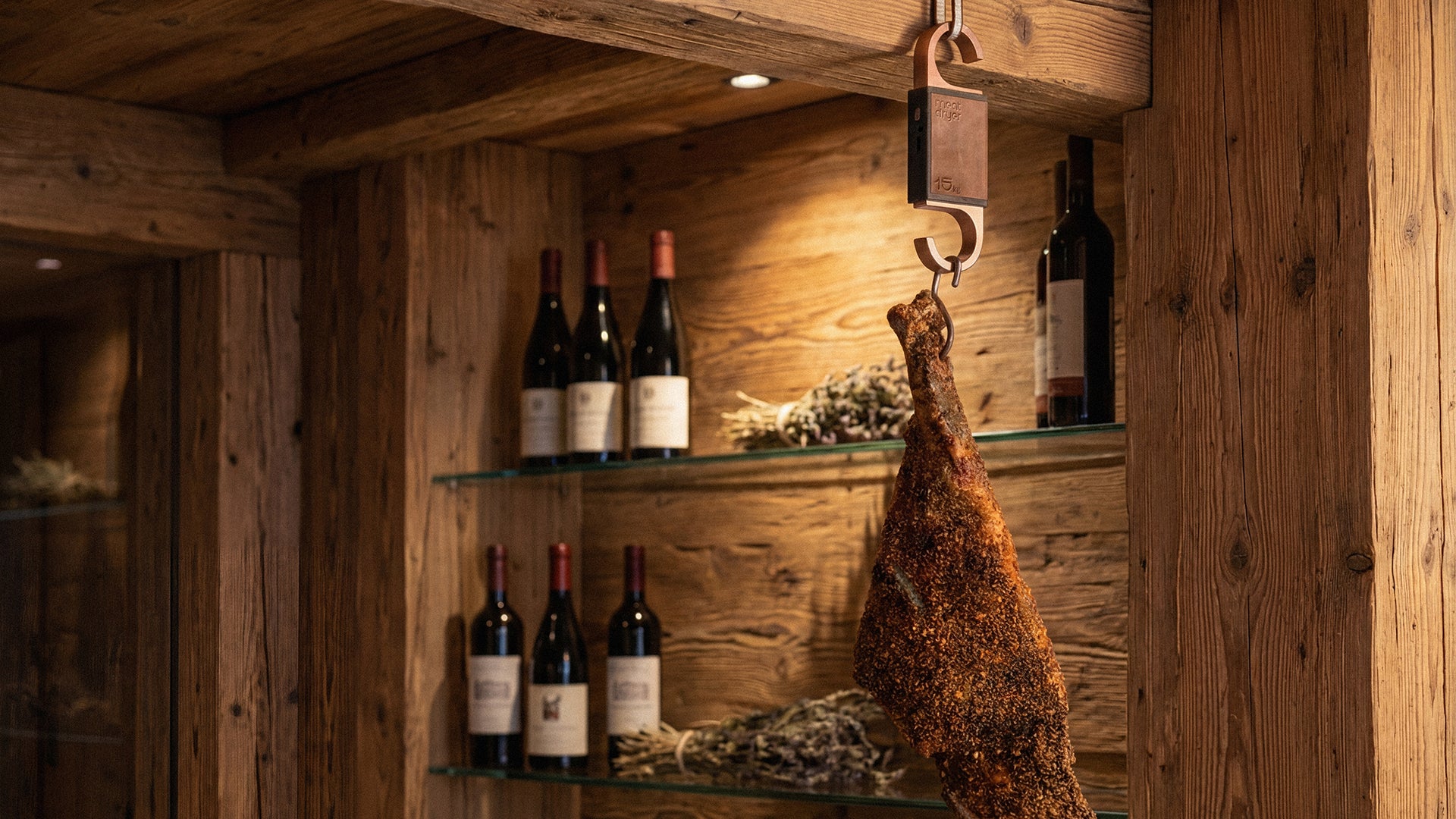
That is the whole job of the hook. It holds the recipe, weighs the meat as it dries, reads the temperature and humidity around it, and tells you when you're there — and flags the drift while there is still time to correct it.
The ancient method
Salt draws water out of the meat, and water is what anything trying to spoil it needs. Take enough of it away and what's left keeps. That much is simple, and people worked it out long before anyone knew why it worked.
Everything after that is knowledge — the kind that took generations to gather. How much salt for this cut. Which spices, in what proportion, rubbed on when. How long, and in what climate, and what to do when the weather turns. An Italian nonna making pancetta is drawing on four hundred years of other people's mistakes, and almost none of it was ever written down for her.
We have captured centuries of that knowledge in the app, with recipes from around the world and the reasoning behind them, so you can start where other people finished.
Nearly everything follows the same five steps. Jerky and biltong are the exception: there a marinade does the salting and the spicing at once, so those two steps become one.
The process, in short:
-
1 — Select the cut
Two ways in. If you already know — a pancetta you love, a bresaola you've been meaning to try — pick the recipe first, then find the cut: your butcher, a farm nearby, or your own hunt. If you don't know yet, look in the fridge or the freezer and let the app tell you what that piece can become.
-
2 — Salt it
Dry, coarse salt straight onto the meat is how most air-dried charcuterie is made. The question is how much: the traditional way, where you bury the meat in more salt than it needs — a bowl or a box in the fridge will do — and let time decide where it lands, or equilibrium curing, where you weigh the meat and add exactly the amount of salt you want.
-
3 — Spice it
Rinse the salt off, then rinse the surface with vinegar — wine, cider or plain. It lowers the surface pH and protects it, and it adds a light tang. Pat it dry. Then a thin film of olive oil, which is what makes the spices hold. Making biltong or jerky? Lift it out of the marinade, pat it dry, and hang it as it is.
-
4 — Hang it, and watch it
On the hook. Curing is decided by weight loss, so the meat hangs from the Meatdryer and is weighed the whole way through, with the temperature and humidity read alongside it. From here it is the recipe and the numbers, and you have both in the app.
-
5 — Eat it. Then improve
Salt level, spice, how far you took the weight — those are taste, not rules. Write down what you did in the Lab, change one thing next time, and you'll have a house style within a year.
About the salt
Most of what's here needs nothing but salt. Coarse, and not iodised.
Some recipes call for a curing salt instead — sold as nitrite salt, pink salt, or by a number. It exists for reasons that matter most in commercial production: long shelf lives, vacuum packing, months between the factory and the shelf. It also holds the red colour people expect from a supermarket slice. Recipes that need it say so, and they say how much.
Nitrite is a regulated additive, and there is a long-running public health conversation about processed meat that we would rather not add to. Our own preference is simple: we avoid curing salt where a recipe does not need it. Everything in our curing guide — pancetta, bresaola, biltong — is made without any.
Store-bought charcuterie usually contains it. Making your own means you decide exactly what goes in. Where a recipe does call for it, follow the recipe, and follow your national food authority.
Hang it anywhere
A kitchen, an attic, a cellar, a garage, a storage room, or outdoors. You do not need a cabinet to start, and you do not need one to get a good result.
What decides where you can hang something is the cut, not the room. Fatty cuts want proper cold — a pancetta or a coppa hung in a warm month will go wrong, and no amount of watching will save it. Lean cuts are the opposite: biltong and jerky have been dried in open air in South Africa for centuries, and a warm dry week is exactly what they want.
So the honest answer to where can I hang it is another question — what are you making, and what month is it? Pick the cut to suit the space you have, and you can start this weekend.
In your home
Outdoors
A dry aging fridge or curing chamber
Most cuts, depending on the season where you live
Most cuts as well, depending on the weather
All of them, fatty cuts included
Autumn through spring for most cuts. Biltong and jerky in the summer
When the weather is dry and cool enough. Lean cuts like biltong and jerky in the warmer months
Always
Somewhere cool and still where the meat is left alone — a kitchen, a cellar, an attic, a pantry, a storage room. A flat works as well
Somewhere dry and out of the rain, and the protective net. Flies find meat faster than you would believe
A bought cabinet, a build, or a repurposed fridge. Airflow is the part that catches people out, and a dehumidifier is usually what fixes it
Nothing
Nothing, plus the net
The most expensive route. A repurposed fridge and a few parts is far less
Cold smoking adds that extra flavour
Smoke before you hang, not after.
Cold smoke is kept cool enough that the meat never begins to cook, so it takes on the flavour and still dries the way it should afterwards. Hot smoke would cook it, and a cooked piece is finished — it cannot go on to become charcuterie.
It comes after the salt, never instead of it. The smoke adds taste; the cure does the work. Alder, beech, oak, fruit woods — each one tastes different, and that is most of the fun.
Smoke does more than flavour, though. It dries the surface a little and leaves compounds behind that discourage mould and bacteria — not enough to preserve anything on its own, which is the cure's job, but enough that a smoked ham and an unsmoked salami hanging in the same room behave differently.
There are four ways in, and the first one costs almost nothing.
Smoke in a grill you own
A cold smoke generator
Build a smoke box
Buy a cold smoker
Wood dust or a smoke coil on a tray, in a covered grill or a closed box
A small unit that smoulders sawdust or pellets on its own for hours. Put it in any closed space — a grill, an old fridge, or the chamber the meat is already hanging in
A wooden box you make yourself, with the smoke piped in from a source standing apart from it. The distance is the whole trick — smoke that travels a few feet arrives cool
A cabinet built for the job, with the smoke generator, temperature control and often automatic monitoring included
Almost nothing — a handful of wood and an afternoon
One inexpensive part
A weekend, some timber and a length of pipe
Plug it in
Finding out whether you like it
Most people, most of the time
Room for a whole ham, and control over it
Smoking often, and wanting the same result every time
-
Ham and whole muscle
Prosciutto, serrano, coppa, lonzino, bresaola. A single muscle, salted, spiced and hung until it has lost the weight the recipe asks for. The slowest of the three and the most rewarding — a whole ham can hang for the better part of a year.
-
Salami and dry-cured sausage
Salami, chorizo, saucisson, spickekorv. Minced, seasoned, cased and hung — not the sort of sausage you fry, but the sort you slice. Tie it with twine so it hangs straight and dries evenly, and expect weeks rather than months.
-
Wild game
Venison, wild boar, moose, roe deer. Lean, which makes it forgiving about temperature and quick to dry. If you hang your own you are already halfway there — the hook takes over the counting.
Curing or dry aging?
The difference that matters is what you get at the end.
Dry aging is about flavour and tenderness in meat you are going to cook. A cut of beef hangs in cold moving air, its own enzymes loosen the fibres, and weeks later it goes on the grill — better than it was, but still a steak, and still something you cook.
Curing is preservation. Salt and spices go on first, the water comes out over weeks or months, and what is left keeps without a fridge and is eaten as it is — sliced thin, raw, the way prosciutto and bresaola have always been eaten.
They are measured differently too. Dry aging usually goes by temperature, humidity and time, so the meat does not have to hang on the Meatdryer at all — keep it nearby and it follows the conditions. Curing is decided by weight loss, so here the meat hangs on the hook and is weighed the whole way through.
Salt and spice before hanging, eaten raw, is curing. Nothing added, cooked afterwards, is dry aging.
Questions
Which one do I need?
The Meatdryer Hook (Green) is our classic — it does the whole job on its own with the right accessories. The Artisan Kit is the premium version: the same measurements, our brown and copper style hook, with an accessory hook and a tool roll to keep it all in.
Do I need the twine and the net?
The twine — tying loops is part of hanging, and always use food safe string. The net, wherever you are hanging somewhere that is not a sealed fridge, where there might be insects around.
Do I need a curing chamber?
No, but it’s next level if you can afford it. A cool still room will do for most of the year, and a spare fridge does the rest. What matters is that you can see what the conditions are — which is the part the hook handles.
How heavy a piece can it take?
Up to 15 kg hanging from the Meatdryer itself. Above that — a full animal, a side — hang the meat from a rail on rigid hooks and keep the Meatdryer nearby. It still follows temperature, humidity and time and works for dry aging, but you lose the weight reading, and on a cure that is the measurement the recipe is aiming at.
Can I do this without curing salt?
For a lot of recipes, yes, and plenty of traditional ones never used it. Where a recipe calls for it, it says so and it says how much. You decide what goes in.
Is mould normal?
White, powdery mould is normal and often wanted. It is the same thing you see on a supermarket salami or the rind of a brie, and it protects the surface while the meat dries. Grey and green often follow it on a long cure and are usually harmless — the test is the smell, which should be earthy and mushroomy. Black is not, and neither is anything that smells wrong. That piece goes in the bin.
A wipe with vinegar and water takes mould off if you would rather not look at it, and plenty of people simply clean it up at the end. But mould that keeps coming back is telling you something about the air, not about the meat — too humid, not enough movement. That is the part the hook shows you.
The outside has gone hard but the middle is still soft. What happened?
It dried too fast. The surface sealed before the moisture in the middle could get out, so now it is trapped — the piece stops losing weight and never really finishes. It is the most common way a first attempt goes wrong, and it is an air problem rather than a salt problem: too dry, too much movement, or both.
It is not always fatal. Vacuum-sealing the piece and leaving it in the fridge lets the moisture even out through it. Better is not to get there, which is what watching the humidity is for.
Salt, spice, hang, weigh. The hook does the last two.